


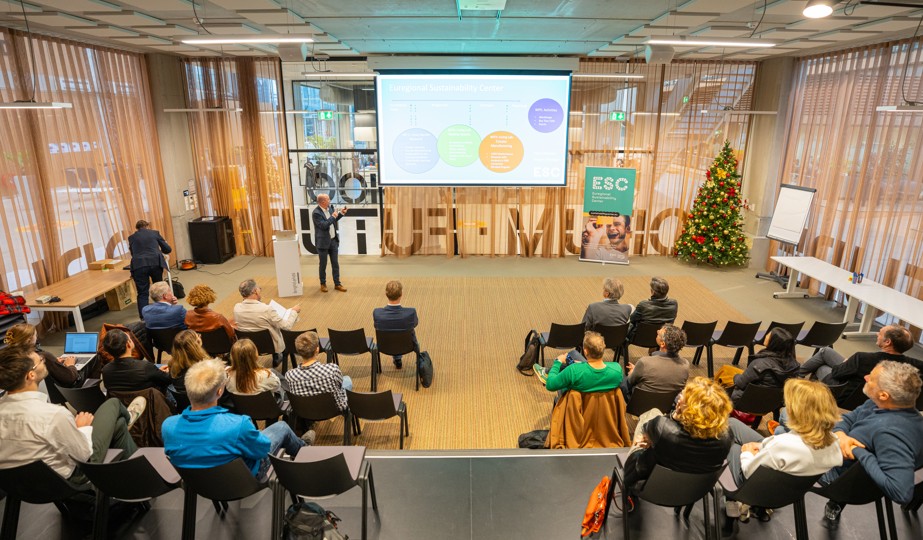
The closing event on 27 November 2025 of the Euregional Sustainability Center (ESC) brought together partners, researchers, students, and regional stakeholders to reflect on achievements, challenges, and future opportunities in cross-border sustainability collaboration. The closing event showcased three years of meaningful cooperation within the ESC program. From circular manufacturing to healthy spaces, from renewable energy challenges to critical raw materials, the event highlighted both the progress made and the work still ahead. With strong partnerships, ambitious regional leaders, and a commitment to practical action, the Euregion has laid a solid foundation for the next phase of cross-border sustainability innovation.
The ESC Project: Four Work Packages
Funded through the Regio Deal, the ESC project launched in November 2023 and centered on four major work packages:
- WP1 – Cross-Border Research
- WP2 – Living Lab Healthy Spaces
- WP3 – Living Lab Circular Manufacturing
- WP4 – Activities & Outreach including a bus tour, workshops, and online webinars.
Energy and resources: urgency at the border Martin Unfried’s contribution showed that there are still very few cross-border energy projects, despite similar ambitions and challenges in the Netherlands and Germany. There are, however, several conflicts, for example regarding wind turbines near the border. In the Netherlands, grid congestion is a major issue, but laying a cable across the border to import electricity from Germany is not permitted under current legislation. For heat, this is allowed, which is why an Interreg project has been launched to explore a joint heating network in Kerkrade (NL) / Herzogenrath (DE).
Report published: Energy Transition in a Cross-Border Context – Mind the Gap
One part of the Regiodeal Project Euregional Sustainbility Center was to investigate what
obstacles hinder the development of cross-border renewable energy projects. In cooperation
with regional stakeholders the ultimate aim was to use the research results to stimulate
practical cross-border projects.